Operational research prototype — live since 29 July 2026
Prototype V3.1 · 5 Aug 2026 — 3,500 executions, 3,476/3,476 unauthorized inputs denied, 0 breaches
// Live-State Authentication

ZEUS X-Trust

We stopped storing conventional secrets. The password does not unlock a vault — it drives a living neural network into a state that either exists, or does not.

ZEUS X-Trust — The only solution for the treasure that counts.™

6–11
orders of magnitude separation
0.0
correct-state drift — bit-exact
18
layer live neural network
0
stored static keys
ACCEPT
DENY
// The mechanism

Authentication without a stored key

ZEUS X-Trust does not depend on a conventional static authentication key stored somewhere for later comparison. The valid authentication relation is generated live — and only reproduces inside the enrolled instance.

01

Password

The password is the only input the user provides. Nothing derived from it is stored for later comparison.

02

Positional map

A password-controlled positional map addresses specific neurons in specific layers of the network.

03

300 iterations

The live neural network runs 300 iterations per authentication and converges into a stable amplitude state.

04

Amplitude profile

The instance-specific amplitude state created during enrollment is compared against the live state.

05

Verdict

Accept only when map and amplitude profile both match. Otherwise: deny.

Two independent separations at once: a wrong password fails at the positional map — a newly initialized instance fails at the amplitude profile. Only the correct password-controlled map inside the enrolled live instance satisfies both conditions.
// Investment

Open for venture capital and strategic investors

ZEUS X-Trust is a prototype that could introduce a new class of cryptography. From this point on, GeoFold AI is actively seeking venture capital and other investors to move it from validated prototype to hardened product.

What is on the table

  • A working, measured prototype — not a concept paper. Every figure on this page comes from documented validation runs.
  • A published preprint and an experimental validation appendix, openly citable on Zenodo.
  • A defined adversarial programme: ~500 controlled scenarios, followed by 20,000+ attack executions and variants.
  • Target markets: agentic operating systems, AI-controlled infrastructure, research institutions, specialised security providers and infrastructure operators.
  • Proprietary source code and implementation retained; methods and selected raw data released under controlled access.
  • Technical due diligence and live demonstration available on request, under NDA.

The download matches your current theme — light or dark.

Direct email only — no contact form, no tracking, no data collection on this site.

Terms & Conditions

All services are B2B only. No products or services are sold via this website; it serves informational purposes. Trauth Research LLC retains full intellectual property rights for all developed models, structures, and technical methods unless otherwise agreed by written contract.

Governing law: Federal Republic of Germany. Place of jurisdiction: Berlin.

Science behind ZEUS X-Trust
Full experimental & adversarial validation record, including the end-to-end prototype campaign · Zenodo
Research log
Stage-by-stage publication of methods and results · LinkedIn
The research behind the venture
Trauth Research LLC
Independent research on informational ontology, emergent geometry and post-quantum AI. GeoFold AI is the deep-tech venture that turns that research into products.
Visit trauth-research.com →
// Measured results

A fully tested prototype — built on documented experimental validation

Start with Appendix C — the completed adversarial validation of the running prototype. Every earlier tab documents the Stage 3–5 validation runs that built up to it.

Appendix C — Controlled adversarial validation of the operational prototype · Prototype V3.1 (5 August 2026)

3,500 authentication executions against one continuously enrolled live instance

A controlled adversarial campaign against the running prototype: 22 attack classes executed against a single live neural instance that stayed enrolled for the entire run — no restarts, no re-seeding, same target file throughout.

3,476/3,476 genuinely unauthorized inputs denied
0 unauthorized ACCEPT · 0 breaches across the entire campaign
~25 h continuous compute across 4 days
22 attack classes tested (14 → 18 → 22)
Same enrolled instance, 300 iterations per authentication run throughout
No stored key: access = password-controlled positional map × live amplitude profile × enrolled neural instance
24 exact-password executions accepted — 20 scheduled positive controls + 4 unplanned generator collisions
*Effective security for a 6-character password modelled at 2²⁵⁶ class — working hypothesis, formal analysis in progress. Roadmap for the next verification layer: independent watchdog (continuous integrity + graduated response) → system-level adversarial testing → external black-box validation.
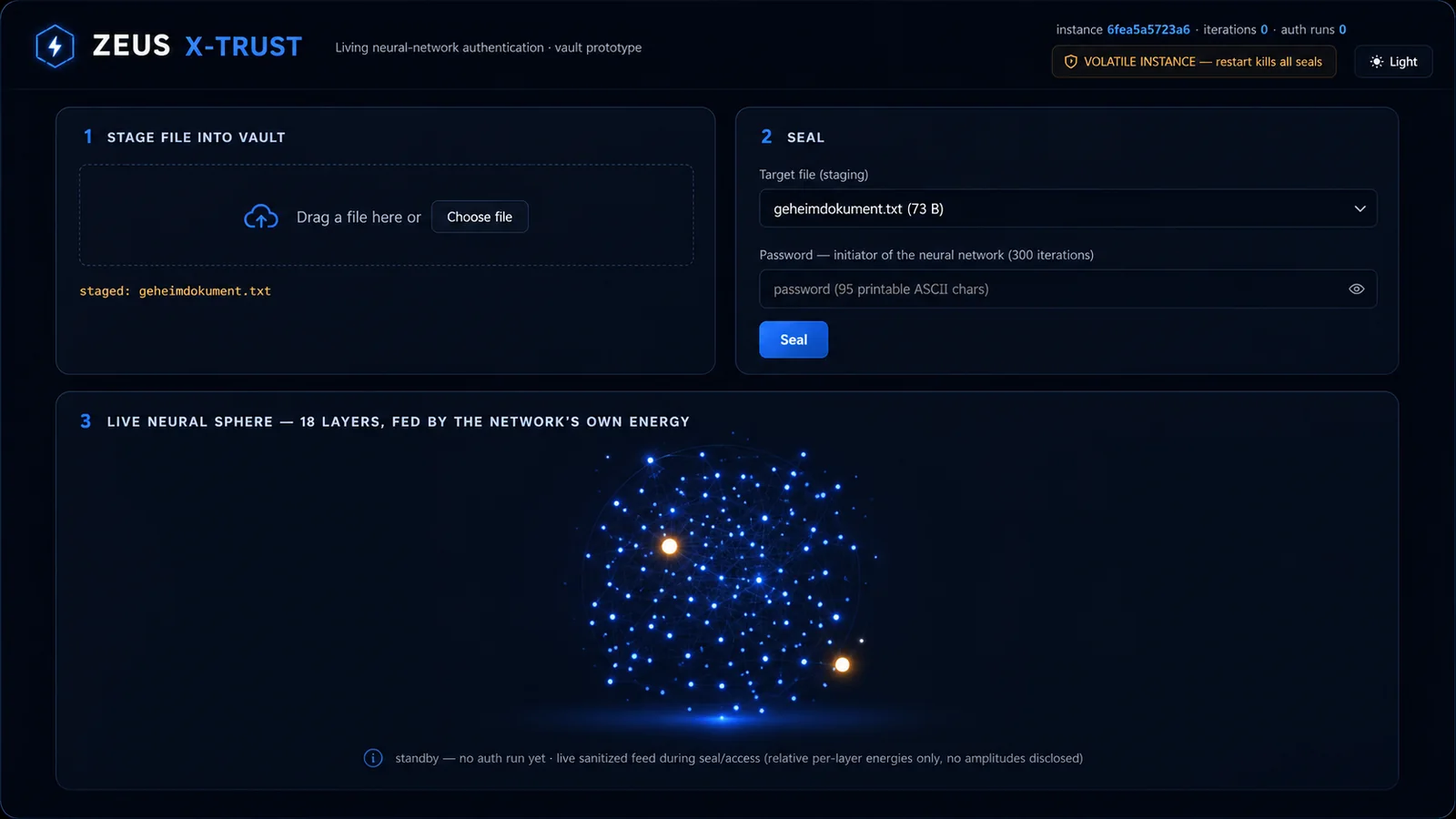
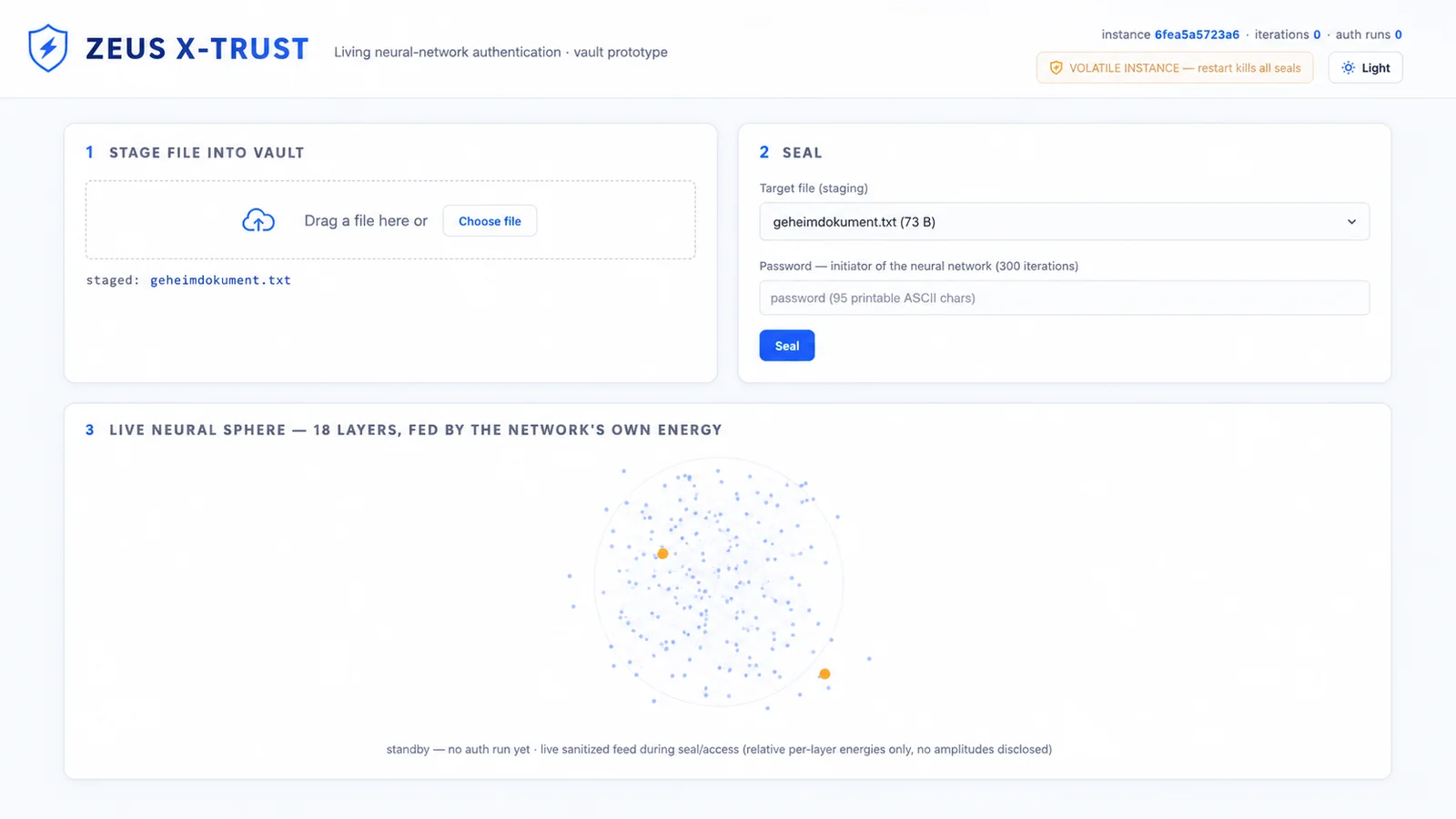
ZEUS X-Trust prototype interface — light theme ZEUS X-Trust prototype interface — dark theme
The operational prototype interface — file staged, seal step, and the live 18-layer neural sphere during an authentication run.
Prototype software — what changed
New in V3 (vs. V2)
Live pyramid display in the verifier UI: real, unnormalized min/max amplitudes of the first pyramid (512→2) at every checkpoint — guided truth; singularity layer, second pyramid, κ and 4weights stay hidden
Convergence display: EVOLVING → CONVERGING → FIXED POINT, with max |ΔA|, correlation and stability share
Processing timeline: input → live-state run → verification → verdict
Event ticker: running log of iterations and verdicts
AUDIT MODE banner, dynamic — red notice on fail-closed
New in V3.1 (vs. V3)
Self-penetration directly in the verifier UI: the participant picks from 10 attack classes (truncation, case mutation, substitution, transposition, dictionary, leetspeak, typo, hybrid, rule-based, brute force) and the number of inputs per class
The server generates the inputs from the enrollment password of the test vault — the participant sees neither the password nor the variants
Time estimate, live progress and a per-input verdict including its attack class
Per-class aggregates: DENY/ACCEPT, mean runtime, match rate, mean drift
Final per-class report as a Markdown download
Attack-class coverage across all campaigns to date: 14 → 18 → 22. The V3.1 figures on this page are the current internal measurement state (5 August 2026) and are deliberately not part of a Zenodo record.
Prototype — first end-to-end test

A working local application with a real 18-layer neural network

Not a simulated interface element. File sealed, authentication gate live, attack variants tested against the enrolled instance.

File successfully sealed · correct password: ACCEPT
32/32 mapped positions matched
Correct-state drift 0.0 — bit-exact
Anagram attack: DENY
Single-character substitution · truncation · case mutation: DENY
Unrelated password: DENY · no NaN or Inf failures
The anagram attack is the revealing case: same characters, different order — still rejected through the live-state component rather than through a simple character-set comparison. Measured separation between the valid state and every tested invalid state: 6–11 orders of magnitude of amplitude separation, with the four-decimal verification window lying inside the empty numerical space between those conditions.
Stage 5 — Integrated authentication logic

Full-run results across 80 individual runs

The complete live-state authentication workflow: correct-login acceptance, rejection of incorrect passwords, instance-specific amplitude-reference binding and protection against reference overwriting during authentication.

40/40 correct logins accepted
360/360 incorrect-password attempts denied
0/40 enrollment references modified
40/40 newly initialized instances denied against the old reference
0 NaN or Inf failures across 80 individual runs
Combined prototype config (Pyramid + 4weights): 10/10 accepted, 90/90 denied
Scope note by the author: Appendix A reports the controlled experimental validation of Stages 3–5. It does not claim independent certification, production deployment, sustained operational exposure, or completion of the Stage 6 adversarial programme. External third-party replication is a separate verification layer.
Stage 4 — Profile vectors & map binding

Binding deterministic password maps to stable live-state amplitude profiles

Validated across all four original FRN architectures, including a separate shared-initialization experiment that isolated the password effect from random initialization.

100/100 valid same-instance references accepted
900/900 wrong-password maps rejected
900/900 obsolete references rejected after re-initialization
Deterministic password maps across all tested architectures
Bit-exact stability within the established live-state plateau
0 of 450 password pairs per architecture were identical
Identical architecture, identical initial weights, only the password changed — and different passwords produced different stable full-network states. This supports the dual role of the password: it defines the map that addresses neural positions, and it influences the stable live state generated from an otherwise identical initialization.
Stage 3 — Plateau stability & distinguishable maps

4 architectures · 400 complete runs · 4,000,000 network iterations

Four original FRN architectures — Original, Pyramid, 4weights, Extended — each with 10 passwords, 10 genuine re-initializations per password and 10,000 iterations per run. Original scripts unmodified, full positional amplitude maps stored and evaluated.

100/100 runs passed Test A for every architecture
10/10 password groups passed Test B for every architecture
Mean intra-window drift: 0 — control window max_diff 0.00000000
No NaN, no Inf, stable late-state plateau throughout
Genuine re-initializations produced distinguishable positional amplitude maps
Euclidean distance as primary metric, Pearson correlation as secondary reference
Key insight: large transient amplitudes are not instability if the final positional amplitudes converge to an exact and persistent plateau. The decisive object is the complete positional amplitude map — which neuron, in which layer, holds which exact amplitude after convergence.
3,476/3,476
Unauthorized inputs denied
0 breaches across 22 attack classes, ~25 h continuous compute — Appendix C
6–11
Orders of magnitude
Amplitude separation between the valid state and every tested invalid state
~6 M
Network iterations (estimated)
Estimated cumulative total across all campaigns to date — Stage 3 alone is documented at 4,000,000
1,300+
Denied attempts
900/900 wrong-password maps, 360/360 wrong passwords, 40/40 stale instances
0
NaN / Inf failures
Numerically clean across every documented validation run

Restart kills the vault — volatility as tamper evidence

The prototype deliberately uses a volatile neural instance. A restarted instance produces a new amplitude realization, the previous enrollment reference becomes invalid and a new enrollment is required. What looks like a limitation is the security property: there is no persistent secret left behind to steal, and any tampering with the instance destroys the authentication relation it was meant to unlock.

No stored static key

There is no key object at rest that can be exfiltrated, cracked offline or recovered from a backup. The relation is produced live or not at all.

nothing at rest

Post-quantum by construction

The attack surface is not a mathematical one-way function but a live amplitude state inside an instance-specific network — there is no algebraic shortcut to invert.

no invertible target

Watchdog validation

An independent watchdog network is in implementation, moving the system from request-based authentication to continuous live-state integrity monitoring.

in implementation
3 days: Stage 5 validation → adversarially tested prototype
29–31 July 2026 — from the documented Stage 5 authentication-logic validation to a completed controlled adversarial campaign: 500/500 attacks denied, 0 breaches, 14 attack profiles, 5.4 h continuous single-instance run. Full detail in Appendix C and the downloadable pitch deck.
// Development path

Where the prototype stands — and what comes next

This is a research prototype. The protected file currently remains unencrypted behind the authentication gate: the present experiment validates the live-state authentication mechanism itself, not yet the complete storage-security layer. That distinction is deliberate.

~1,700 h
Human research time invested
~200 GB
Validation data generated
~120 M
Tokens consumed from first idea to today (in + out)
~800 h
From design to running prototype
Stages 3–5 validated
Plateau stability, map binding and integrated authentication logic documented in Appendix A.
Operational prototype live
Local application with a real 18-layer network, first end-to-end test passed.
Removal of research-only password storage
Eliminating the last research-grade convenience from the implementation.
Controlled attack campaign — 3,500 executions, completed
3,476/3,476 unauthorized inputs denied, 0 unauthorized ACCEPT, 0 breaches, 22 attack classes, ~25 h continuous compute. Methodology published as Appendix C.
Independent watchdog implementation
Continuous live-state integrity monitoring instead of request-based authentication.
Encrypted storage integration
Completing the storage-security layer behind the authentication gate.
Large adversarial campaign — 20,000+ executions
More than 20,000 distinct attack executions and variants, with published evaluation material.
// The system behind the system

Built by an agent architecture, directed by one scientist

The operational prototype was not produced through a conventional software-development process. It was designed, implemented, tested and consolidated inside a local agent architecture — with research direction, architecture and scientific interpretation remaining with Stefan Trauth.

A
Apollon
routes
M
Medusa
plans
P
Pandora
builds
K
Kosmos
plans the outcome

Apollon routes. Medusa plans. Pandora builds. Kosmos plans the outcome. All four are a product of GeoFold AI — a deep-tech venture by Trauth Research LLC.